IPS TFT LCD vs Standard TFT LCD: Which Display Technology Fits Your Project?
Sep 23, 2026
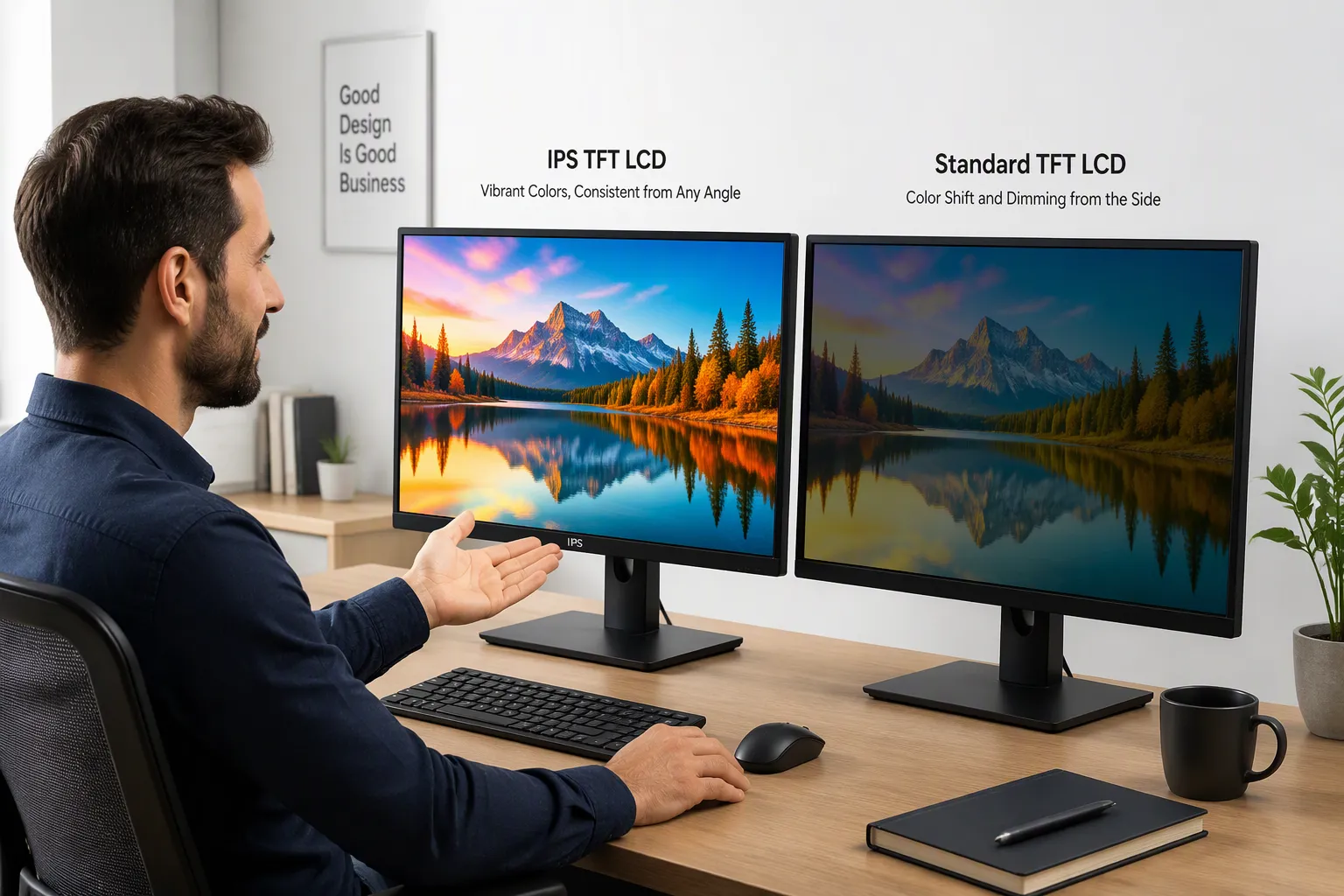
The right choice between IPS and standard TFT LCD hinges firmly on project priorities. If cost and response speed take precedence, standard panels serve well. If visual quality and wide viewing angles define the application, IPS reigns. It is crucial to recognize that IPS represents a panel variant within the TFT LCD family, not a separate technology. This article examines key parameters—viewing angle, color reproduction, response time, cost—and maps them to real-world applications. Engineers gain a practical framework for selecting the optimal display, balancing trade-offs with each requirement.
Key Takeaways
IPS panels excel in viewing angles and color accuracy, ideal for shared or color-critical applications.
Standard TFT panels offer faster response times and lower cost, perfect for single-user or budget projects.
Consider your project's priorities: viewing angle, color fidelity, speed, and cost determine the best choice.
IPS panels now match standard TFT in speed for most uses, but still carry a price premium.
Customization options and supplier support help tailor either panel type to your specific needs.
What Is IPS TFT LCD?
IPS TFT LCD is a panel variant built on the same active-matrix structure as every other TFT display. It is not a competing technology. The thin-film transistor array still switches each pixel, and the liquid crystal layer still modulates light. The difference lies in how the crystals align and move.
How In-Plane Switching Works
In a standard twisted nematic panel, liquid crystal molecules sit in a twisted structure. When voltage applies, the molecules untwist and tilt out of plane. Light transmission then varies greatly with viewing angle, which causes color distortion.
IPS takes a different path. Both the pixel electrode and the common electrode sit on the same substrate. A voltage creates an electric field that runs mainly parallel to the glass surface. The liquid crystal molecules rotate sideways within the plane instead of tilting vertically. This in-plane rotation changes the polarization of light passing through the liquid crystal layer, which controls how much light reaches the upper polarizer.
IPS technology enhances viewing angles and color accuracy by keeping liquid crystal molecules parallel to the panel surface.
The result is more uniform light transmission. IPS panels also resist pressure well. Unlike PMVA panels that can show temporary marks when touched, an IPS screen stays stable under finger presses or mounting stress.
Typical IPS Use Cases
IPS panels appear across consumer and professional markets. Smartphones, tablets, laptops, and digital cameras rely on them for everyday color accuracy. Industrial applications include manufacturing controls, medical devices, and logistics screens. Retail and hospitality deploy IPS in POS terminals, self-service kiosks, and digital signage. Transportation uses them in aircraft, automotive dashboards, and train control panels.
IPS offers superior contrast and color accuracy with wide viewing angles (170°+). It is the standard for medical, automotive, and multi-operator industrial systems where consistent visibility from any position is critical to operations.
Any project that demands a wide viewing angle and stable color from multiple positions benefits from this TFT LCD variant.
What Is Standard TFT LCD?
A standard TFT panel refers to a twisted nematic display driven by an active matrix. TFT itself is a driving method within LCD technology, not a separate display type. The thin-film transistor array sits behind each pixel and switches it rapidly. This architecture enables fast addressing and improves brightness, contrast, depth, and color.
How Twisted Nematic TFT Works
A TN screen contains multiple layers. An extremely thin twisted liquid crystal layer sits between glass plates. Those plates carry transparent electrodes, alignment layers, color filters for color versions, and external polarizers.
In the natural state with no voltage applied, liquid crystal molecules arrange in a twisted helical structure. This structure rotates the plane of polarization of incoming light by 90 degrees. A second polarizing filter sits 90 degrees relative to the first filter. The rotated light aligns with it and passes through, producing a bright pixel.
When voltage applies, the electric field forces molecules to untwist. The untwisted molecules no longer rotate light polarization by 90 degrees. The second polarizer blocks the light, producing a dark pixel. By controlling voltage per pixel, the degree of twist modulates light passage and enables different brightness levels.
Typical Standard TFT Use Cases
Standard LCD still makes sense for fixed values, symbols, and low-power operation. Basic TN panels often use static or passive driving for simple character or dot-matrix displays. These applications prioritize low cost and minimal power draw over color richness.
The active matrix version becomes the choice for color and frequent updates. TN-TFT versions, commonly called standard TFT panels, use active matrix driving via thin-film transistors. Consumer electronics, industrial meters, and budget instruments rely on this approach. The technology delivers adequate performance where wide viewing angles and premium color fidelity matter less than cost and speed.
Viewing Angle
IPS Across Angles
IPS panels achieve exceptional viewing angle performance through their liquid crystal alignment. The molecules sit horizontally, parallel to the glass substrate. When voltage applies, these crystals rotate within the same plane rather than tilting vertically. This in-plane rotation represents the defining mechanism behind the technology. Since the crystals move within a consistent plane, the viewing angle exerts minimal impact on color or brightness. Light passes through the liquid crystal layer more evenly, reducing the angular dependence of light modulation. Consequently, an IPS display remains clear and vivid even at sharp viewing angles. Typical IPS panels offer up to 178 degrees in both horizontal and vertical directions.
The following table compares viewing angle performance across panel types:
Panel Type
Viewing Angle Range
Image Consistency at Angles
TN or VA LCD
Approximately 90° to 120°
Image darkens or colors distort when viewed from the side or top
IPS
Up to 178° both horizontally and vertically
Maintains color accuracy and brightness, ensuring consistent image from nearly any direction
Engineers designing multi-operator systems benefit from this consistency. A control room with multiple workstations, a medical device shared between clinicians, or a retail kiosk approached from different angles all demand stable image quality. Operators viewing the screen from the side, above, or below see the same color accuracy and brightness.
Standard TFT Off-Center
Standard twisted nematic panels behave differently at off-center positions. The twisted liquid crystal structure relies on molecules tilting out of plane when voltage applies. This vertical tilt scatters light unevenly when viewed from an angle. Color shifts occur, particularly toward warmer or cooler tones. Brightness drops noticeably as the viewer moves away from the center axis.
The effective viewing angle for a typical TN panel ranges from approximately 90 to 120 degrees. Beyond this range, the display loses contrast and color fidelity. A user standing to the side of a standard TFT LCD sees a washed-out image with inverted colors in extreme cases. This limitation originates from the fundamental asymmetry of the twisted nematic structure. Light passing through the panel at an angle encounters a different effective birefringence than light passing straight through.
This limitation does not affect all applications equally. Single-operator devices, fixed-mount instruments, and cost-sensitive products may tolerate the narrow viewing cone. However, any project requiring shared viewing or multiple operators demands a panel that avoids such degradation.
Color And Image Quality
Color Reproduction Differences
Color performance separates these two panel variants more than any other parameter. A standard twisted nematic cell modulates light through molecular tilt. That tilt changes the effective path length of light through the liquid crystal layer. Different wavelengths experience different polarization changes. The result is a narrower color gamut and visible color shift across gray levels.
IPS cells rotate molecules within the plane. Light passes through a more consistent optical path at every gray level. This consistency produces a wider color gamut and more accurate color tracking. An industrial TFT display built on IPS technology reproduces skin tones, brand colors, and subtle gradients with far greater fidelity.
When Color Fidelity Matters
Not every project needs premium color. A pump controller showing numeric readouts functions perfectly on a standard panel. A basic instrument cluster with fixed icons has no need for wide gamut coverage.
Other applications cannot compromise. Medical imaging demands accurate tissue differentiation. Retail signage must match brand color specifications. Automotive dashboards require consistent color under varying light. A high-resolution TFT LCD module with IPS technology serves these needs directly.
Shengfeng supplies both panel types and helps engineers match color requirements to budget. A custom TFT LCD panel from Shengfeng can target specific gamut and brightness targets for any application.
Response Time
Speed Advantages Of Standard TFT
Response time measures how fast a pixel switches from one gray level to another. Standard twisted nematic panels hold a clear edge here. Their molecules untwist and tilt out of plane with very little resistance, so the cell changes state quickly. Gray-to-gray response times for TN panels typically fall between 4 and 10 ms without overdrive. VA panels, the other common standard variant, run much slower at 14 to 30 ms.
That speed advantage explains why competitive gaming monitors favored TN for years. Fast motion stays sharp, and ghosting stays minimal. A fast panel also suits applications that refresh data rapidly, such as waveform monitors or high-speed industrial gauges. Designers who prioritize motion clarity over color often accept the narrower viewing cone as a fair trade.
IPS In Real Applications
IPS panels once lagged behind TN in switching speed. Typical gray-to-gray response times now land between 8 and 16 ms without overdrive. That range sits between TN and VA, and it covers most general-purpose work well. Office monitors, medical displays, and industrial control panels rarely demand sub-millisecond switching.
Gaming-grade IPS panels have closed most of the historical gap. Current models achieve gray-to-gray response times around 1 millisecond, matching TN panels at the same figure. VA panels sit near 4 to 5 ms in that comparison, while OLED reaches roughly 0.1 ms. Modern IPS gaming monitors also support refresh rates up to 240 Hz and beyond.
An industrial TFT display built on IPS technology therefore handles fast-updating interfaces without visible blur. Engineers no longer need to sacrifice color quality for speed. The remaining trade-off is cost, not capability. For most projects, an IPS panel delivers adequate motion performance alongside its viewing angle and color strengths.
Cost And Power
Price Differences
IPS panels carry a higher price tag for structural and manufacturing reasons. Each pixel in an IPS panel requires two transistors to drive the liquid crystal molecules horizontally, while a standard TFT LCD uses only one transistor per pixel. This transistor count doubles the complexity of the thin-film transistor layer, increasing material cost and lowering fabrication yield. The two-transistor design also increases the number of photolithography steps during fabrication. Each additional step introduces a risk of defects, further reducing the number of functional panels per wafer. The structural design of IPS panels blocks slightly more of the backlight. To achieve the same brightness as a standard panel, an IPS display must incorporate a stronger backlight. That stronger backlight adds to the bill of materials. The production cost for IPS rates as moderate to high, compared to low for a standard twisted nematic panel. The price gap has narrowed as IPS manufacturing matured over the past decade, but the premium persists for high-brightness or large-format panels. Engineers should expect this premium when selecting IPS for color-critical or wide-angle applications.
Power Draw Considerations
The relationship between panel type and power consumption is not straightforward. IPS panels may require stronger backlights to maintain high brightness and uniform appearance, which can increase power draw in battery-powered or portable devices. A standard panel generally offers better efficiency under comparable conditions, making it better suited where power saving matters most.
IPS displays are not necessarily always more power-hungry than standard TFT; actual power use depends on backlight design and brightness targets, though IPS may require more power to achieve consistent performance at wide angles.
An IPS panel with an efficient LED backlight and reduced brightness target can match or even beat a standard panel with an inefficient backlight. The assumption that IPS always consumes more power overlooks practical design variables. For always-on applications such as POS terminals, the appropriate choice depends on the specific brightness requirement and thermal budget rather than a general rule. A POS terminal running sixteen hours per day accumulates significant energy cost over a five-year lifespan. The difference of even a few watts between panel types can translate into noticeable operational expense. Engineers must evaluate the backlight subsystem and the intended operating conditions before concluding which panel delivers lower lifetime power cost.
Matching TFT LCD To Your Application
Selecting the correct TFT LCD variant requires a structured evaluation of the operating environment, user interaction, and budget constraints. Engineers define thermal limits, ambient light levels, viewing distance, and the number of simultaneous viewers. This mapping determines long-term reliability, user satisfaction, and total cost of ownership. For short-term or cost-driven projects, a standard TN panel offers an acceptable solution. For long-term industrial, medical, or outdoor equipment, an IPS LCD is frequently the more stable and visually reliable choice. Notably, 4:3 LCD panels provide higher vertical resolution usage, which enhances vertical display efficiency in industrial data visualization dashboards.
Best Fits For IPS
The medical device industry represents a primary domain for IPS technology. Patient monitors require stable color representation from multiple viewing angles to ensure clinical staff read vital signs accurately from across the room. Portable diagnostic devices, such as handheld capnographs and pulse oximeters, depend on color-coded alarms to indicate patient status. A standard TN display can wash out these critical colors under strong hospital lighting, posing a safety risk. IPS guarantees that red warnings remain vivid and distinguishable. Accurate color reproduction directly impacts diagnostic confidence. Shengfeng’s medical-grade display technology ensures compliance with stringent healthcare standards.
Outdoor kiosks, automotive dashboards, and industrial HMIs demand sunlight readability and thermal stability. An IPS panel paired with a robust backlight achieves 3,000 to 5,000 nits of brightness, ensuring visibility under direct sunlight. Standard TFT LCDs typically struggle to exceed 2,000 nits without sacrificing lifespan. Field tests confirm that a 10.4-inch IPS panel remains fully readable under simulated sunlight at 10,000 lux, with no significant color shift. Furthermore, IPS technology operates reliably across a wide temperature range, from -30°C to +70°C. Shengfeng’s sunlight-readable displays leverage IPS technology to deliver consistent performance outdoors.
For control rooms and transportation displays, the 178-degree viewing angle of IPS is indispensable. Operators standing at the side of the screen see the same accurate image as the primary user. This consistency reduces misinterpretation and improves workflow. The engineering rule is simple: for mission-critical, human-centric systems, IPS is the superior choice. Shengfeng’s industrial TFT display module provides the durability required for these demanding applications.
Best Fits For Standard TFT
Standard TFT panels retain a strong foothold in consumer electronics and cost-sensitive applications. Budget televisions, entry-level monitors, and digital signage use standard LCD technology to offer competitive pricing while maintaining adequate performance. The widespread adoption of LCD has driven down costs significantly, making advanced features like 4K resolution more accessible in these value-driven segments.
Single-user devices present another ideal use case. A fixed-mount industrial controller or a simple point-of-sale terminal serves one operator directly in front of the screen. In these scenarios, the narrow viewing cone of a twisted nematic panel does not create a disadvantage. The faster response time of standard TN panels (4 to 10 ms) also benefits applications displaying rapidly changing data. For simple user interfaces that rely on fixed symbols or numerical readouts, the color limitations of standard TFT panels become irrelevant. Engineers can prioritize cost and power efficiency without degrading the user experience. Shengfeng’s standard TFT LCD panels offer a cost-effective solution for these straightforward applications.
Customization And Sourcing
Tailoring Displays To Your Design
Every industrial project demands a display that fits specific mechanical, electrical, and optical constraints. Manufacturers offer extensive customization services to match either IPS or standard TFT LCD panels to unique design requirements.
Custom FPC design allows engineers to adjust shape, pinout, and cable length for tight enclosures. Cover glass treatments include anti-glare (AG), anti-reflective (AR), and anti-fingerprint (AF) coatings. Optical bonding using OCA or liquid adhesive improves sunlight readability and shock resistance by eliminating the air gap between cover glass and display. Touch panel integration supports capacitive or resistive technology with custom touch FPC and controller selection. Brightness enhancement to 1000+ nits enables outdoor deployment. Interface adaptation matches host system requirements through SPI, RGB, LVDS, or MIPI options. Engineers can also modify LCD size, resolution, backlight configuration, and operating temperature range. Mechanical integration services extend to mounting brackets, metal frames, and housing structures. Front panel elements such as buttons and indicators can be embedded directly into the display assembly.
What To Ask Your Supplier
Interface selection directly influences design flexibility and system cost. Engineers must evaluate trade-offs between RGB, LVDS, and MIPI DSI interfaces when choosing a panel for their project. RGB offers simplicity for moderate resolutions but carries high pin count and layout complexity, making it less suitable for high-resolution or long-distance applications. LVDS provides robust signal integrity for long cable runs in noisy industrial environments and requires fewer pins than RGB. MIPI DSI delivers very high bandwidth for compact, high-resolution devices but demands careful PCB design and host compatibility. Each interface choice affects development difficulty, system cost, and scalability.
Suppliers should provide documentation for compliance certifications and reliability testing to validate their panels for industrial use. Essential certifications include RoHS and REACH for environmental compliance across global markets. For automotive or safety-critical projects, request AEC-Q100 qualification evidence and ISO 26262 functional-safety documentation. Qualification cycles and power budget specifications must align with the project timeline to avoid costly delays. Engineers should also request information about the display driver IC supply chain, including wafer fabrication sources and assembly methods such as COF or COG used for thin-bezel panels. A supplier that delivers clear specifications, certification evidence, and test data ensures a smoother transition from prototype to mass production.
The core trade-off stays simple. IPS wins on viewing angle and color accuracy, while standard TFT LCD wins on cost and response speed. Readers should revisit their top priorities before choosing. Budget, environment, and user experience map directly to the comparison points above. A single-operator, cost-driven device tolerates a narrow viewing cone. A shared, outdoor, or color-critical system does not. Customization options and supplier support then close the gap between a standard panel and a perfect fit. Engineers who consult a display partner early avoid redesigns later and reach production with confidence.
FAQ
What distinguishes IPS from standard TFT LCD?
Engineers evaluating a high-resolution display must consider crystal alignment. IPS rotates molecules horizontally, maintaining color at wide angles. Standard TN tilts them vertically, causing color shift. Viewing angle requirements dictate the optimal choice.
When does a standard TFT panel fit best?
A standard TFT LCD fits single-operator devices and cost-sensitive projects. The narrow viewing cone creates no disadvantage when one user works directly in front. Speed advantages also benefit rapidly updating interfaces.
Can IPS panels handle outdoor environments?
Yes. Shengfeng's industrial TFT display with IPS paired with a high-brightness backlight achieves sunlight readability. These panels operate reliably from -30°C to +70°C. Outdoor kiosks and automotive dashboards commonly use them.
Are IPS panels always more expensive?
The price gap has narrowed. Sunlight-readable displays with IPS now compete closely with standard panels for many sizes. Volume production reduces the premium. Engineers should evaluate total cost including backlight and brightness requirements.




 Network Supported
 Language


 Call Us: