
search
What Are You Looking For?

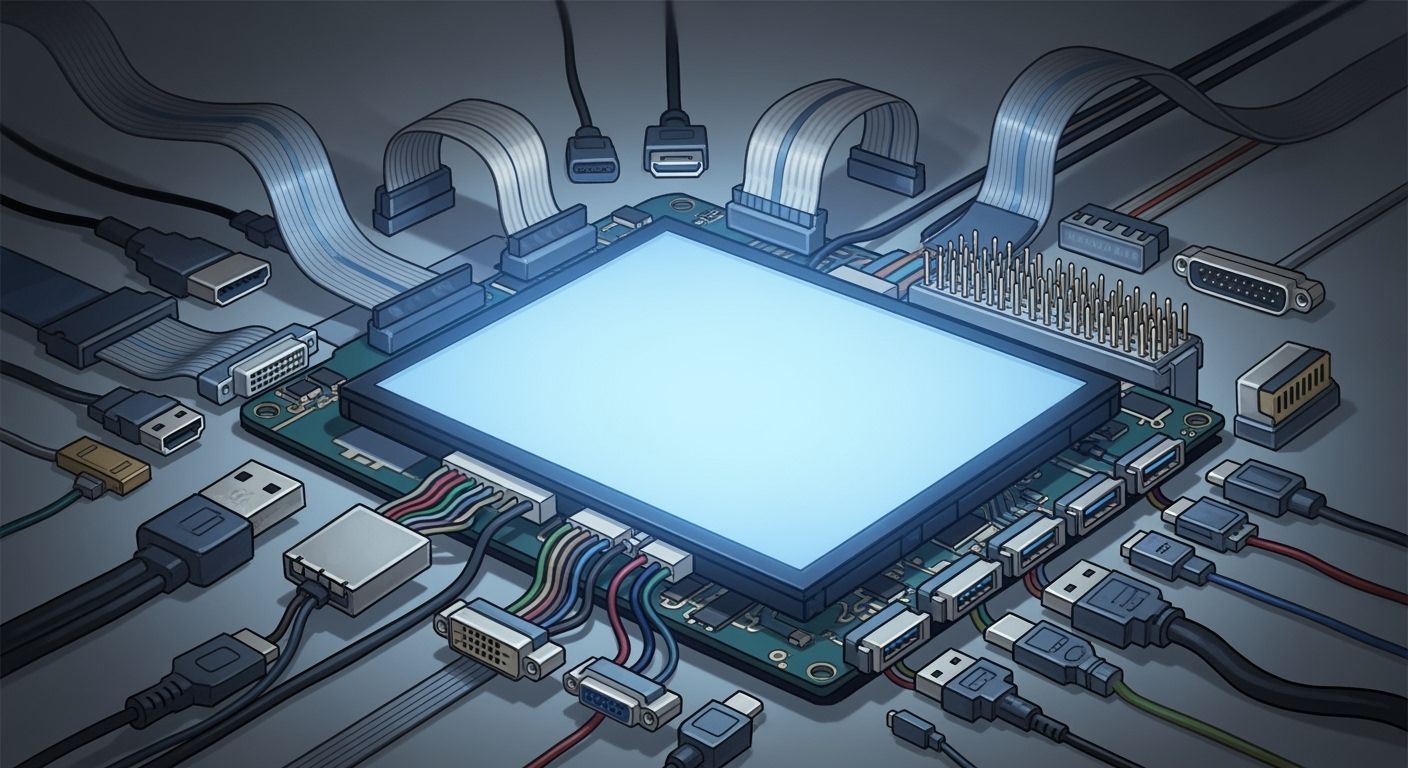
You will encounter several common interfaces when working with a TFT LCD Display, including MCU (8/16-bit parallel), SPI, RGB (TTL), LVDS, and MIPI DSI. Each interface brings distinct features, advantages, and trade-offs, which influence your project’s design and performance. For example, LVDS-interface panels account for more than 35% of industrial monitor shipments globally as of 2024.
|
Interface |
Pin Count |
Max Speed |
Power Profile |
Best Use Cases |
|---|---|---|---|---|
|
RGB (Parallel) |
24–28 pins |
60+ Hz |
High |
Graphics, HMI, industrial panels, video |
|
MCU (8/16-bit) |
8–24 pins |
Low–Medium |
Moderate |
Embedded systems, smart appliances, meters |
|
SPI (Serial) |
4 pins |
Up to 30 MHz |
Ultra-low |
IoT, battery devices, small portable displays |
|
LVDS |
4 pairs |
High speed |
Moderate |
Large panels (>10″), industrial, automotive, notebooks |
|
MIPI DSI |
1–4 lanes |
Gigabit |
Efficient |
Mobile, automotive, high-resolution, FHD+ displays |
You need to understand these differences to select the right interface for your application.
Understand the different TFT LCD interfaces: MCU, SPI, RGB, LVDS, and MIPI DSI. Each has unique features that suit specific applications.
Choose the right interface based on your project needs. Consider factors like display content, power consumption, and installation space.
For battery-powered devices, opt for SPI or MIPI DSI. These interfaces offer low power consumption and fewer pins, making them ideal for compact designs.
Use LVDS for high-resolution displays in industrial and automotive settings. It provides excellent noise immunity and supports long cable lengths.
Evaluate your application’s requirements carefully. The right interface choice can enhance system reliability and user experience.
You encounter several interface types when connecting a TFT LCD Display to your system. Each interface offers unique features and suits specific applications. Below, you will find a brief introduction to the most common interfaces and their typical usage contexts.
The MCU interface connects directly to microcontrollers or microprocessors using 8 or 16 parallel data lines. This interface simplifies integration for compact displays and keeps the Bill of Materials cost low. You benefit from straightforward firmware development and reliable operation in embedded systems. Many smart appliances and meters use this interface because it supports low-power designs and minimizes complexity.
|
Characteristic |
Description |
|---|---|
|
Direct connection |
Works with 8-bit or 16-bit microcontrollers |
|
Simple integration |
Ideal for compact displays |
|
Cost efficiency |
Reduces BOM and firmware complexity |
SPI uses serial communication to transfer data between your host and the TFT LCD Display. You only need a few pins, which makes it perfect for space-constrained designs. SPI supports both 3-wire and 4-wire modes, allowing flexibility in command and data handling. You often see SPI in IoT devices, battery-powered products, and small portable displays. Typical data rates reach up to 30 MHz, which is suitable for basic graphics and text.
|
Mode |
Description |
Signal Logic |
|---|---|---|
|
3-wire 9-bit |
Data/command bit in serial packet |
Fewer pins, combined stream |
|
4-wire 8-bit |
Separate D/C pin for command/data |
Common, easy for MCU platforms |
RGB (TTL) interfaces send pixel data directly from your host to the TFT LCD Display. This method ensures high responsiveness and supports high resolution. You need more signal lines compared to SPI or MIPI, which increases connector size and PCB complexity. RGB is ideal for industrial equipment, home appliances, and medical interfaces. Many medium to large displays rely on RGB for continuous data streaming and real-time graphics.
|
Feature |
Description |
|---|---|
|
Direct pixel transfer |
Responsive, high resolution |
|
Higher pin count |
Increases connector and PCB complexity |
|
Continuous streaming required |
Host must constantly send data |
|
Suitable for medium/large displays |
Used in industrial and medical applications |
LVDS stands out for its ability to transmit high-resolution data over long distances. You gain excellent noise immunity and reliable performance in industrial environments. LVDS is the preferred interface for large TFT LCD Display panels, especially in automotive, industrial, and professional-grade applications. You can maintain image quality even with extended cable lengths.
|
Advantage |
Description |
|---|---|
|
Long-distance transmission |
Maintains image quality |
|
High bandwidth |
Handles high-resolution data |
|
Noise immunity |
Reliable in industrial settings |
|
Large panel support |
Ideal for professional applications |
MIPI DSI delivers gigabit-level data rates using one to four data lanes. You benefit from efficient power consumption and flexible operational modes, including command and video modes. MIPI DSI supports modern RGB formats and adapts to high-resolution requirements. You often find this interface in mobile devices, automotive displays, and advanced consumer electronics. Debugging requires attention to pixel clock, lane rate, and sync configuration.
|
Specification Type |
Details |
|---|---|
|
Operational modes |
Command and video modes |
|
Physical layer |
MIPI D-PHY, 1 clock lane, 1–4 data lanes |
|
Signaling states |
High-speed and low-power modes |
|
Data formats |
RGB565, RGB666, RGB888 |
|
Timing requirements |
Horizontal/vertical sync, refresh rate |
Tip: LVDS and MIPI DSI interfaces dominate the automotive and industrial sectors, while MCU, SPI, and RGB (TTL) remain popular in consumer electronics and embedded systems.
You connect the MCU interface directly to your microcontroller using parallel data lines. The microcontroller sends commands and pixel data through 8 or 16 pins, along with control signals such as read/write and chip select. This setup allows you to manage the TFT LCD Display efficiently, especially in embedded systems. The parallel transfer ensures reliable communication, but you must handle timing and synchronization in your firmware.
SPI enables you to transfer data serially between your host and the TFT LCD Display. You use four main signals: MOSI (Master Out Slave In), MISO (Master In Slave Out), SCLK (Serial Clock), and CS (Chip Select). The full-duplex protocol lets you send and receive data at the same time. SPI operates at high speeds, which is faster than I²C and UART. You can control multiple devices with one master, and you select the data length to match your display requirements. This flexibility makes SPI suitable for LCD, OLED, and TFT displays.
Full-duplex data transfer for simultaneous communication
High-speed operation for quick display updates
Master-slave architecture for multi-device control
The RGB (TTL) interface transmits pixel data in parallel. You use separate signal lines for red, green, and blue channels, plus synchronization signals like horizontal and vertical sync. Each channel sends 8 bits per pixel, totaling 24 bits. The host streams pixel values continuously, and the display renders colors in real time. Clock and sync signals ensure precise timing, which is essential for accurate image reproduction.
Note: This method provides real-time rendering and high responsiveness, making it ideal for industrial and medical applications.
LVDS uses low-voltage differential signaling to transmit data across paired copper wires. The driver generates a constant current, and the direction of flow indicates binary data. The receiver detects voltage differences, which represent the transmitted information. This differential approach cancels out common-mode noise, ensuring high signal integrity and minimal electromagnetic interference. LVDS consumes little power and maintains a low bit error rate, which is crucial for large panels and environments with high interference.
MIPI DSI achieves high-speed data transfer by using differential signal pairs called lanes. You can use one to four lanes, depending on your resolution and refresh rate needs. This design reduces pin count and supports efficient communication. MIPI DSI handles high resolutions and fast refresh rates, making it ideal for compact devices like smartphones and automotive displays.
Differential lanes for fast transmission
Efficient pin usage for streamlined design
Supports high-resolution and rapid refresh rates
If you need reliable and advanced display solutions, Shengfeng offers a range of TFT LCD Display modules with these interfaces, ensuring compatibility and performance for your project.
You will find the MCU interface ideal for straightforward embedded applications. It connects directly to microcontrollers, which makes integration simple and cost-effective for basic tasks. However, you may encounter limitations in speed and memory when handling complex graphics or larger displays.
|
Aspect |
Advantages |
Disadvantages |
|---|---|---|
|
Speed |
Higher processing power and faster data transfers |
Increased complexity in programming |
|
Power Consumption |
Lower costs for simpler applications |
Higher power consumption for complex MCUs |
|
Cost |
More affordable for basic tasks |
Larger code sizes can challenge memory constraints |
Typical use cases include:
Basic motor and relay control systems
Consumer gadgets such as remote controls, toys, and kitchen appliances
Smart home products, sensor nodes, and portable medical accessories
If you need a reliable solution for simple control systems, consider the MCU interface TFT LCD Display modules offered by Shengfeng.
SPI interfaces give you a compact and flexible way to connect your display, especially in space-constrained designs. You benefit from high data transfer rates compared to I²C and UART, but you will face speed bottlenecks with larger or high-refresh displays.
|
Interface |
Data Transfer Speed |
Pin Count |
|---|---|---|
|
SPI |
High (up to 100 MHz) |
At least 4 lines + CS |
|
I²C |
Medium (up to 5 MHz) |
2 lines |
|
UART |
Low |
2 lines (plus ground) |
Limitations of SPI:
|
Limitation |
Description |
|---|---|
|
Speed Bottleneck |
Prevents use in large panels or high-refresh graphics. |
|
Best Suited For |
Small displays under 3 inches and low-refresh applications. |
|
Example Products |
SPI-based products like S029HQ05NS (2.9″ bar 320×120) and S019BQ01HN (1.9″ 170×320) serve specific applications. |
You should choose SPI for small, battery-powered devices, IoT modules, and wearables. For a wide selection, explore SPI TFT LCD Display modules from Shengfeng.
RGB (TTL) interfaces deliver real-time, high-resolution graphics, which makes them suitable for industrial and medical displays. You must manage a higher pin count and increased electromagnetic interference, especially as display size and resolution grow.
|
Limitation |
Description |
|---|---|
|
Higher EMI |
RGB (TTL) interfaces are prone to increased electromagnetic interference. |
|
Limited cable length |
The effective distance for signal transmission is restricted. |
|
Difficult PCB routing |
At higher resolutions, routing becomes more complex due to the number of signal lines. |
You will see RGB (TTL) used in:
Industrial equipment and HMI panels
Medical devices requiring real-time graphics
Home appliances with medium to large displays
For robust and responsive solutions, Shengfeng provides RGB interface TFT LCD Display modules designed for demanding environments.
LVDS stands out for its ability to maintain signal integrity and support longer cable lengths. You can use it for high-resolution displays in industrial and automotive settings. However, you must consider the need for dedicated transmitters and receivers, which can add to system complexity and cost.
The LVDS interface enhances signal integrity and supports longer cable lengths in TFT LCD Display systems by utilizing differential signaling. This method improves noise immunity, allowing for data transmission over longer distances without signal degradation. Unlike standard digital I/O that operates with a single voltage level, LVDS employs a dual wire system that effectively cancels out common-mode noise, thus maintaining high signal integrity even in electrically noisy environments.
|
Advantages |
Disadvantages |
|---|---|
|
Supports higher resolutions (up to Full HD) |
Requires a dedicated LVDS transmitter/receiver |
|
Fewer signal lines than RGB |
|
|
Good noise immunity |
|
LVDS is best for:
Large industrial monitors
Automotive dashboards and infotainment
Professional-grade video and imaging systems
Shengfeng’s LVDS interface TFT LCD Display modules offer robust performance for high-end applications.
MIPI DSI interfaces give you high data rates, low power consumption, and a compact design. You can achieve ultra-high resolutions in mobile and portable devices. You need to manage more complex initialization and debugging, but the benefits often outweigh these challenges.
|
Advantage |
Description |
|---|---|
|
High Data Rates |
Supports extremely fast data transfer, enabling high-resolution displays up to 4K and beyond. |
|
Low Power Consumption |
Efficient data encoding reduces power usage, critical for battery-powered devices. |
|
Compact Design |
Fewer pins and smaller connectors allow for slimmer designs and simplified PCB layouts. |
You will find MIPI DSI in:
Smartphones and tablets
Automotive instrument clusters and infotainment
High-resolution portable medical and consumer devices
For advanced projects, Shengfeng supplies MIPI DSI TFT LCD Display modules that meet the latest industry standards.
You need a clear overview when comparing interface options for your project. The table below summarizes the most important parameters for each interface. This helps you quickly identify which interface aligns with your technical and budget requirements.
|
Interface |
Data Speed |
Pin Count |
Power Consumption |
System Cost & Complexity |
Best Use Cases |
|---|---|---|---|---|---|
|
MCU (8/16-bit) |
Medium (up to 80 MHz) |
High (8–18) |
Moderate |
Low |
Embedded, smart appliances |
|
SPI |
Up to 50 MHz |
Low (4–6) |
High efficiency |
Low |
IoT, wearables, small displays |
|
RGB (TTL) |
Medium (up to WVGA) |
High (18–24+) |
Medium-High |
Moderate |
Industrial, medical, HMI |
|
LVDS |
High (Full HD+) |
Medium (10–20) |
Medium |
Moderate-High |
Automotive, large panels, pro video |
|
MIPI DSI |
Very high (Full HD+) |
Low (4–8) |
Low |
Moderate-High |
Mobile, automotive, high-res portable |
You can see that interfaces like SPI and MIPI DSI use fewer pins and offer high power efficiency, while RGB and LVDS support higher resolutions but require more complex hardware.
Selecting the right interface for your TFT LCD Display depends on several factors. You should evaluate your application’s needs before making a decision. Consider the following criteria:
Display Content: Decide if your screen will show static images, dynamic graphics, or video.
Touch Functionality: Determine if you need touch input and if the interface supports it.
Operating Environment: Assess lighting conditions, temperature range, and exposure to dust, liquids, or impacts.
Electromagnetic Interference: Check if your device will operate near strong electrical noise.
Installation Space: Measure available space for connectors and cables.
Usage Intensity: Analyze how often and how long the display will run.
System Cost and Complexity: Balance the cost of additional hardware (like LVDS transmitters) against your budget and development resources.
Power Consumption: Prioritize low-power interfaces for battery-powered or portable devices.
Pin Availability: Match the interface to your microcontroller’s available pins.
Tip: For automotive or industrial applications, you should prioritize interfaces that offer high noise immunity, support for long cables, and robust performance in harsh environments.
You can match each interface to specific applications for optimal results. Here are some practical recommendations:
Wearable Devices and IoT: Choose SPI or MIPI DSI for compact size, low pin count, and high power efficiency. These interfaces work well in smartwatches, fitness trackers, and portable medical monitors.
Industrial Controls and HMI Panels: Select RGB (TTL) or LVDS for real-time graphics, wide viewing angles, and reliable operation in noisy environments. These interfaces suit factory automation, test instruments, and equipment status displays.
Automotive and Large Panels: Use LVDS or MIPI DSI for high-resolution dashboards, infotainment, and vehicle auxiliary gauges. These interfaces handle long cables and resist electromagnetic interference.
Consumer Electronics and Smart Appliances: Opt for MCU (8/16-bit) or SPI for simple integration and cost-effective designs. These interfaces fit kitchen appliances, remote controls, and sensor nodes.
Note: TFT-LCD modules with MIPI, RGB, or SPI interfaces deliver reliability, brightness, and wide viewing angles for medical equipment, industrial systems, and handheld devices.
If you want a reliable solution, Shengfeng offers a wide range of MIPI DSI TFT LCD Display modules and SPI TFT LCD Display modules that meet industry standards for performance and compatibility. Shengfeng’s expertise ensures you find the right interface for your project, whether you need a high-speed automotive display or a low-power wearable screen.
When you select the right interface, you improve system reliability, reduce development time, and optimize user experience.
You must select the right TFT LCD Display interface by considering your application’s requirements. Each interface offers unique strengths in speed, pin count, and power efficiency. Review these critical factors:
|
Factor |
Importance |
|---|---|
|
Display size & resolution |
Matches mechanical design and visual needs |
|
Viewing angle technology |
Improves visibility in public or multi-angle settings |
|
Brightness & contrast |
Ensures readability in challenging environments |
|
Touch interface |
Supports user interaction and environmental demands |
|
Operating temperature |
Maintains stability and safety |
Shengfeng provides expert guidance and reliable display solutions. Match interface choice to speed, cost, complexity, and compatibility for optimal results.
You should select SPI or MIPI DSI. These interfaces use fewer pins and consume less power. Shengfeng offers modules with both interfaces, making them ideal for wearables and portable electronics.
Yes, you can use the MCU (8/16-bit) interface for direct connections. This method simplifies integration and reduces system cost. Shengfeng provides compatible display modules for easy development.
MIPI DSI supports the highest resolutions, including Full HD and 4K. You can use it for advanced mobile devices and automotive displays. Shengfeng’s MIPI DSI modules deliver excellent image quality.
Yes, you should use LVDS for industrial settings. It offers strong noise immunity and supports long cable runs. Shengfeng’s LVDS modules ensure reliable performance in harsh conditions.
You should use differential signaling interfaces like LVDS or MIPI DSI. These interfaces minimize EMI and improve signal integrity. Shengfeng’s display solutions help you achieve stable operation in demanding environments.
Please read on, stay posted, subscribe, and we welcome you to tell us what you think.


Copyright © 2017 Guangdong Shengfeng Technology Co., Ltd. All Rights Reserved.Sitemap | Blog | Xml | Privacy Policy  Network Supported
 Language


 Call Us: